

It is easy to be dismissive of the éleveur business model of creating Armagnac by ageing and blending eau de vie made by others, when elsewhere, houses aim to control every aspect of the process, from the vineyard to the bottle.
But in Armagnac, as in Champagne, some of the most awesome (and I use that word in its truest sense) skills of all are needed to find, age and blend the best Armagnacs from artisan producers throughout the region to produce a marriage of Armagnacs better together than they are apart.
As with whisky, there are spendy Armagnac blends as revered as vintage or varietal bottlings, but at the same time, blends at all levels are vital to the success of Armagnac as a spirit. This is because they perform an invaluable function, giving newcomers a benchmark they can expect for both consistency, and quality. High quality levels are incredibly important. If quality is lacking, consumers look to alternative spirits, and the whole industry suffers.
 Blends are also a “must have” in any back bar. (The miniature cask shown is for barrel-aged cocktails – huge in the USA!). Bartenders need a flavour profile they can rely on to deliver the perfect serve time after time. They also crave unique expressions to build their reputations for unique high quality cocktails. A blend needs enough character to match up with other ingredients, and to deliver a perfect balance of the cocktail elements.
Armagnac blends are ideal for cocktails. The low distillation temperature results in a very characterful spirit right from its emergence from the alambic, let alone once it has aged, and the infinite style permutations available due to the range of grapes, soils, alambics and producer styles gives plenty of scope to create reliable blends of individuality and distinction.
Huge effort goes into making even the least aged blends as good as they can be at an affordable price point. While Armagnac producers revel in their uniqueness, every single house I have visited has been extremely proud and protective of the quality of their products.
Marquis de Montesquiou is one such house. With the benefit of the resources available from its parent business Pernod Ricard, they create Armagnacs at all levels, volumes and budgets which are made from eau de vie sourced from their trusted partner producers, and aged in their “cathedral” cellar under the watchful eye of Eric Durand, their respected cellarmaster. I visited one of their partners and saw first hand the craftsmanship and attention to every detail they put into their Armagnacs, so Marquis de Montesquiou seem to have have chosen their sources very well.
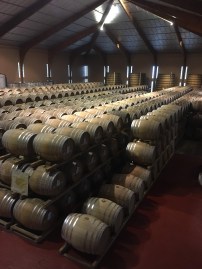 Ghislain Dumas guided Amanda Garnham of BNIA and I through a tour and tasting on my recent visit to the Armagnac region. The “cathedral” cellar was impressive. As is usual in Armagnac, there is a short maturation in new oak followed by a longer maturation in older oak barrels (sometimes called “double maturation”), and then for blends, a gradual reduction in strength by adding demineralised water blended with armagnac (“petites eaux”) until bottling strength of 40% is reached. The cellar is dry (as opposed to humid), which is relatively unusual.
 The blending vessels can be huge, the largest used for quality supermarket bottlings. These vessels are rarely empty; a proportion of the blend is kept inside so that when the new spirit is added, it can be “married” not only with the blend ingredients, but also with the previous blend, so that the end result is as near as possible in character to the previous bottling.
Both Marquis de Montesquiou and Comte de Lauvia (made by Marquis de Montesquiou) blends are popular in The Wine Shop Winscombe, so what are they all about?
 We compared the Marquis de Montesquiou XO with the Lauvia Hors d’Age. The former has spirit aged 10-25 years old from grape varieties Ugni Blanc, Baco and a small proportion from Folle Blanche. The latter is a blend of Armagnacs made between 1975 and 2000, again mostly from Ugni Blanc and Baco.
The house styles are very different from each other. The Marquis de Montesquiou is likened to a full orchestra with a full and satisfying range of flavours, i.e. fruitiness, spiciness, and oak flavours, at an affordable price point with a correspondingly shorter finish. If necessary it is adjusted. The curious bottle shape is inspired by the flasks used by the Musketeers. The XO is a glossy coppery mahogany colour with enticing aromas and flavours of raisins, dates, walnuts, coffee, cinnamon, clove and well integrated sandalwood. It is a pleasingly complex rounded mouthful of characterful flavours in balance with its structure. A satisfying all rounder.
The Comte de Lauvia is so different. Ghislain explained that it is more like a jazz band than an orchestra with a specific range of high tone and vanilla notes, and a long finish. It is not chill filtered so as to preserve its character, so it isn’t as shiny bright as a finely filtered Armagnac. UK drinks importer Emporia were very much instrumental in the creation of this range. The Hors d’Age is deep amber. The aromas are elegant and floral, with notes of orange blossom, toasted almond, vanilla, marzipan and pastry, fruity notes reminiscent of a good rum, and ageing flavours of fig and nuts. The finish is long. All colour is natural. Adjustment is only gradual reduction to bottling strength. Elegant, unique to its house style.
It is easy to see why bartenders gravitate towards these ranges – and there are plenty of inspiring recipes for budding mixologists to try out on the Marquis de Montesquiou website. You could even use both ranges in one cocktail to flesh out the flavour profile!
In the Wine Shop Winscombe we have the Lauvia Fine (which is equivalent to VS with a minimum ageing of 1 year) and the Reserve (equivalent to VSOP, minimum ageing of 4 years). The Fine is relatively simple in profile, with the same house style of fruity floral aromas, prunes and pastry but with a surprisingly long finish. The Reserve is my favourite of the Lauvia range. Expect a range of flavours including prune, fig, coffee and honey, a smooth texture, and a lovely lingering finish. Sip from a small tulip shaped glass with quality chocolate nearby to nibble in between – dark chocolate ginger thins perhaps?
 Ghislain also showed us a trio of vintages with standout flavour profiles which they use in blending masterclasses. The 1973, with oaky character, was very herbaceous, with a robust tannic structure, cooling peppermint aromatics and length. The 1976 was more spicy, with sandalwood, prune juice, clove, cinnamon, tobacco and a fiery bite of black pepper. The 1989 was the floral element. It was highly perfumed with acacia and herbal aromas, and deep prune and tarte tatin flavours. The finish was shorter.
Had time permitted it would have been fun to make our own blend, and we could see how a blend of these three elements could create a quality Armagnac greater than the sum of its parts.
 Although alas we didn’t taste any of them, Ghislain also showed us recent bottlings of a range of premium blends of various spirits in the La Distillerie Générale range, including Armagnacs from Marquis de Montesquiou’s cellar, with luxurious fabric labels which fetch high prices. These are limited bottlings of 35cls each – the Armagnac “Réserve Cathédrale Single Cask”, is of 830 bottles. There is also a Folle Blanche Single Cask. Sadly they are not available in the UK as far as I know.
So it’s not all about scale. The team here, despite the larger scale of their cellar, is aspirational in terms of quality. Expect more limited release bottlings from this house.
My overall impression of Marquis de Montesquiou is that it neatly exemplifies the rise and rise of quality in Armagnac as a whole, and the role played by everyone in the region, at whatever scale their business may be, in driving up quality levels. Houses like Marquis de Montesquiou are a vital part of the future of Armagnac. Long may they be there to look after their artisan partners.
Marquis de Montesquiou Fine Armagnac, and Comte de Lauvia Fine and Reserve Armagnacs are available from The Wine Shop Winscombe (01934 708312).
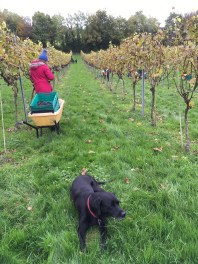 The Fords are one of Somerset’s farming families, so harvest time is very much a family affair. To fit in with the family theme, and it being half term week, my daughter Eva and our lovely but wayward black labrador Arthur came along too.
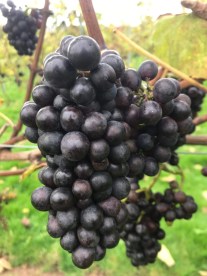 Luke waited until the last moment to harvest the Pinot Noir. This autumn was damp and cool so ripening was slow. It was worth the wait. Pinot Noir can ripen too quickly becoming rather “overcooked” in flavour without the complexity for which it is prized. But this year the wine should be very complex because ripening was so gradual. Acid levels dropped sufficiently, while sugar levels rose gently. As the weather was about to turn wet again, Luke decided that there was no benefit to waiting any longer, so we were summoned to the vineyard on what proved to be the last dry day for some time. Pinot Noir bunches are tightly packed like pine cones, hence its name, with thin skins – perfect for mould to set in – so it was best not to leave it any longer.
 Despite the weather, the grapes were remarkably rot free, which no doubt reflects what is a good site on a sunny slope. Luke says the quality of the Pinot Noir grapes this year was “fantastic” (must be the expert pruning…..!?). Luke advised us that the grapes would be de-stemmed at the winery, so we simply needed to snip the bunches without trimming too much off. But as there are no luxuries such as optical sorting tables in this vineyard, we did need to be vigilant and snip off any mouldy and/or unripe grapes. Luckily there was little of either, since I rather doubt Eva would have had patience for too much snipping. I also had to contend with Arthur taking himself off to every corner of the vineyard sniffing out pheasants.
 Harvesting is done rapidly at Sutton Ridge. All of us knew we needed to crack on in order to get our hearty lunch, served with a refreshing drop of rosé. As you can see, Arthur particularly appreciated the lunch offerings.
 It has been an absolute pleasure to visit Luke and his lovely family at Sutton Ridge throughout 2019. Although a small vineyard, quality is undoubtedly the watchword here, and this shows in the wines which are big favourites in our household, and which are gaining in recognition – see for example write ups appearing in Decanter magazine. I had no hesitation in taking a bottle of Luke’s rosé to Armagnac as a gift for my host during my recent tour of the region; I am confident that she will enjoy it every bit as much as we do.
 So in 2007 I bought 6 bottles of Domaine Font-de-Michelle Cuvée Etienne Gonnet Chateauneuf du Pape AOC 2005. I gave the details to my god daughter’s parents in case anything happened to me. We then forgot about it while the Wine Society stored it.
 Enough about the wine, let’s talk money! I paid £125.00 for the wine. When it arrived in the UK I paid £31.29 duty and VAT. Storage charges per annum vary but based on last year’s charges The Wine Society estimate that I paid around about £43.20 in total i.e. £4.32 per annum. My total spend therefore comes to approximately £199.49. The 2005 is no longer available via The Wine Society and I don’t have access to LivEx to value the wine. I could ask a merchant to value it but I’m not selling so that would be naughty. The Wine Society was selling the 2009 for £39 a bottle, i.e. £234 for 6. Assuming the 2005 is worth the same, total “profit” is therefore £34.51 i.e. 17.3% over 12 years – I might have made more had I called it off sooner! I therefore (almost) bought 5 bottles and got one free. It doesn’t sound much but if you buy in any scale it starts to seem shrewd. Though to be honest, I’m not sure it competes with buying wine in France and bringing it over duty free – or just moving there!
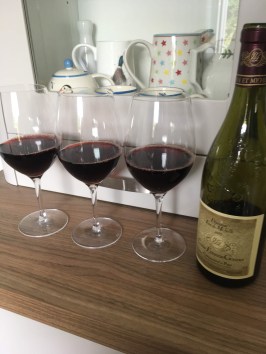 My god daughter turned 18 this year, so what does she think of it I hear you ask? Sadly, for reasons I won’t go into, her health is such that she can’t partake of much of it. She has kept a bottle to share with her family, and I have bought the rest from her – like any 18 year old she is content with cash!
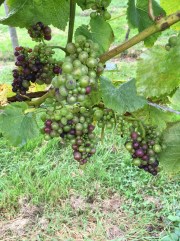 Véraison marks a new phase of promise at Sutton Ridge; the changing colour from green to black of Regent, then Pinot Noir, evidences ripening (from the photos you can see that aside from the colour, Regent has far looser bunches than tightly packed Pinot Noir). Sugar levels are rising, acidity levels are falling. The anxious wait until harvesting now begins.
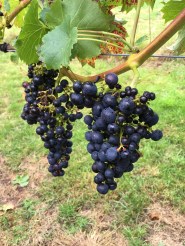 So much can go wrong – damp conditions cause mildews which can set in during the window between the last spray and the harvest; pests want their share of the crop; poor weather can mean ripening is slow and might not happen at all, especially if véraison is delayed. After a changeable summer, I wondered whether véraison would be later than usual but it is happening on schedule, Regent grapes already deep black while Pinot Noir is turning now, a couple of weeks later.
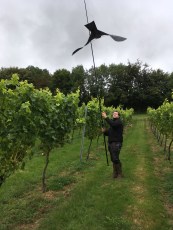 So how is Luke protecting his crop? His bird scarer had been felled by strong winds (here he is resurrecting it), and already one vine beside a hedge appeared to have been raided, perhaps sparing its neighbours from a similar fate. Badgers had already dug latrines into which they had deposited seed laden stools and bare stalks as evidence of their brazen theft. An electric fence probably won’t deter them; Luke accepts some losses to the furry thieves. Deer, too, expect their share. Luke has deer fences, but no barrier is completely deer proof, it seems.
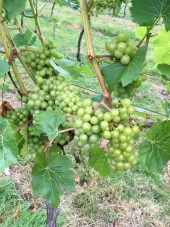 Fortunately, although 2019 is not as bountiful a year as as 2018, there seem to be plenty of grapes to go around. Luke isn’t planning any green harvesting, sometimes carried out around now, to lower his yields this year (he green harvested his Seyval Blanc (see right photo) last year to aid ripening). But he is de-leafing to maximise air circulation and sun exposure, which will also make the harvest easier. He is also picking out any signs of disease from each bunch by hand. So there is plenty to do!
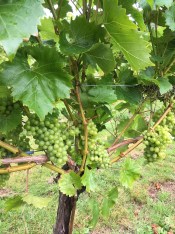 Despite growing 5 different grape varieties, Luke expects to harvest for 2-3 weeks from mid October. Luke plans to use all his Pinot Noir for sparkling rosé as he did last year. His still rosé comes from Regent and Phoenix (see left photo), the proportions variable according to how much of each there is. His 5 rows of Regent produce less than his 4 rows of Phoenix, so it ends up about 60/40 or just about even. The grapes are co-fermented together rather than separately and then being blended, giving what Luke believes is a better integration of flavours. Regent gives a dark colour so in 2017 Seyval Blanc was added to adjust the colour to a more Provence-style pale salmon.
  Bacchus (see right photo) is used for still white wine. Luke would like to make a still Pinot Noir red one day, but would need to plant more vines and acquire an oak barrel! One day maybe…..
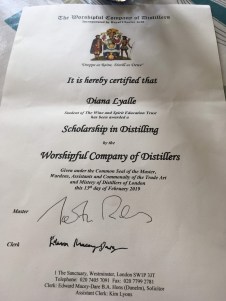 As is evident from my reflections on WSET Diploma graduation (see previous blog), I was never favourite to land a prize for the spirits exam – but somehow, I scored highly enough to receive the Worshipful Company of Distillers’ Scholarship which funds me to study a spirit producing region!
 I was also encouraged to visit a distillery; Cotswold Distillery hosts a friendly and informative tour. They were distilling grappa when I dropped by, from pomace (spent grape skins) donated by a Gloucestershire vineyard, and I met their new still, called Dolly (she works 9 to 5….). When I explained why I was there, they gave me a “doggie bag” of tasty tipples for me to dissect at home. Their whisky was one of few spirits I tasted which I classed as outstanding. I also admired their genever equivalent. I can’t recommend their tour highly enough, both to students and to consumers – and the whisky is available from The Wine Shop Winscombe.
 The theory exam also involved luck. As a lawyer, I had learnt the legal requirements for scotch whisky verbatim, and even looked up the regulations (sad….) – cue a “brain dump” which probably scored very highly when this question came up. Less lucky was a mandatory question on Poire William. Usually questions about more unusual spirits offer a couple of options – but not today! All I knew was that it was made with Williams pears in France and that in at least some examples a whole pear is inside the bottle (the lovely lady at Divine Wines I met at a trade tasting said she had a bottle in her shop and it looked pretty on the shelf). That was my first and only sentence for some time until the initial exam panic receded. I then realised I had to choose which spirit production method to write about – maceration with pears, or making a pear cider and distilling it. I went with the latter and forgot about it until the results came out. (By the way, the bottle is placed over the pear bud on the tree! The pear grows inside.)
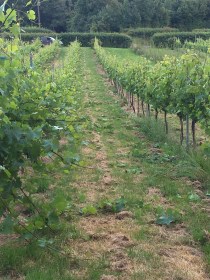 As promised, here is a belated update from Sutton Ridge – this time following a visit on an idyllic midsummer’s evening (3rd July 2019). Luke was advising a family hoping to plant a vineyard in the Cheddar area, chilled rosé in hand, from a vantage point on a high grassy bank overlooking the vineyard, Blagdon Lake and the Mendips.
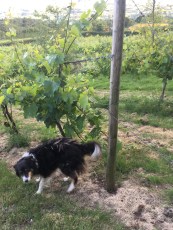 Merely 10 weeks ago in late April the vineyard was neat and tidy with its first leaves of the season showing. Now look at it! After a long dry spell, June brought abundant rain and the vines have responded by throwing out shoots left right and centre. Here is Flo doing her bit to bring order to the chaos.
 self pollinate, so there are no attractive blooms to lure in pollinating insects (except the roses planted as early warning signs of disease). Neither is there much scent to speak of, although vineyards tend to have a honey-citrus perfume around flowering time.
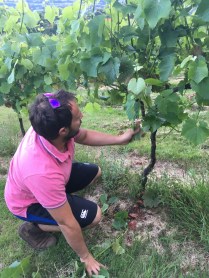 After flowering, Luke loses no time in spraying against disease, aided by his neighbours at Aldwick Estate who have a tractor with air conditioned cabin for this purpose. But there is no chance of getting a tractor along the rows at the moment without damaging the vines. So the race is on to tuck in the unruly waving arms (see top photo – right has been done, left still unkempt) and at the same time thin out shoots and canes so sunlight and air can penetrate the canopy. Care has to be taken, however, because when leaves reach 50-80% of the maximum size they help the vine build up sugars needed for the next year, so pulling off too many at this stage could jeopardise the health of the vine for the following harvest. So management of the leaf canopy continues throughout the growth cycle since leaves at maximum size start to contribute decreasing amounts of sugars and can be more safely removed.
 Already the variation in how tightly packed the bunches will be is evident. The black skinned variety Regent (see photo) has relatively open, spaced out flowers, so the resulting grape bunches should be at less risk of mildew.
 white flower perfume lifts the aroma profile. Smells classy. High acidity, very clean, pure and precise in the manner of a Riesling, with additional distinct white peach and nettle flavours, with a tangy bite balanced by a creamy weight on the palate. Long if delicate finish. A very good wine that really sings.
 It was my annual privilege recently to attend the Harvest Supper at Aldwick Estate in Somerset and to receive my hard earned wine “wages” for my toil in the vineyard last autumn – which followed a long hot summer, so great things are expected particularly from the red grapes, Regent and Pinot Noir. These wines won’t be released yet but the whites and a rosé should be available very soon.
 Sandy’s update on the past year was short and sweet, but suffice it to say that this ambitious estate goes from strength to strength. A telling statistic is that production of grapes has risen from 8 tons in 2013 to a whopping 42 tons in 2018! This was at least partly due to the exceptionally favourable 2018 vintage, which produced a bumper crop across our green and pleasant land. It was so huge a crop that the winery didn’t have enough slots available to vinify it all. Another reason is the increased number of pickers. 70 were involved in the 2018 vintage, and 60 were there for the supper. Sandy’s sister Carol, a professional chef, is back from Spain and her tasty spreads are fast establishing a reputation for quality.
 After a chat with the delectable Mary herself, I tasted this year’s rosé. Pale salmon in colour, this is delicate yet weighty and I thought there was a slight spritz. There were restrained tangy redcurrant, loganberry and cranberry flavours on the nose, but this wine is all about the palate. There was real depth of jammy strawberry flavour, with a creamy texture. The finish was long, and evolved into notes of apricot. It might not have oodles of complexity but the length, evolution and depth of flavour more than compensates.
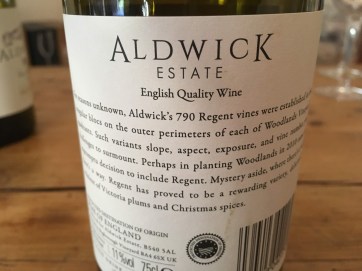 A pale ruby-red wine with a purple tinge. An inviting intense nose of plum jam, tinned strawberries, cherries and spice with hints of rose hip and hedgerow fruit. Velvet smooth on the palate with low tannins but enough alcohol to balance with the flavours. Although a light red, it is not thin and weedy like English reds tend to be. It has enough depth and complexity to be satisfying, and a hint of Italian style sourness on the finish makes it an attractive food match – try lightly chilling it for optimal balance and crack open with charcuterie. Be quick – I have just read that it got a Decanter World Wine Awards Bronze medal so it won’t be about for long!!!
 Kings County Distillery’s Straight Bottled in Bond Bourbon (see photo) from New York City came about when a chap from a dry part of Kentucky began ageing his moonshine. To be Bottled in Bond the whiskey has to be 50% abv, at least 4 years old and distilled in one season only, i.e. not blended. It has gongs aplenty. It is pale mahogany in colour and exudes powerful intense aromas of prunes, marzipan and brazil nuts with some floral hints. Others would say cherries and chocolate. I felt it needed a little water – but I added too much which rendered it soapy – oops! It’s £33.99 for 200ml reflecting its individuality and intensity.
 There is a quiver of excitement in vineyards the world over when the bare skeletons of pruned vines suddenly reawaken after their long winter rest. Despite the many vineyard tasks and eternal vigilance which will now be needed to reap rewards at harvest, budburst (aka budbreak) represents the promise of the forthcoming vintage, especially exciting this year in Somerset after the bumper quality crop in 2018. Each bud contains everything the vine needs – new shoots, lush leaves, tendrils for clinging, and clusters which will bring forth flowers, and hopefully, lots of healthy grapes.
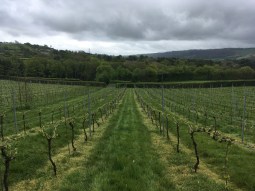 So you can imagine how it felt to gaze over the gate upon the Pinot Noir vines we pruned last month, now tied down and, quite literally, bursting into life.
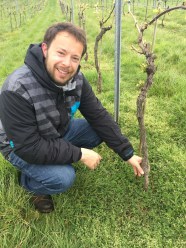 The weather since my last visit had been largely dry until this week, so the canes were unusually brittle and some snapped off when tied down. Other than than, as you can see, Luke seems pleased with progress so far. He aims for buds about a fist length apart on the canes to give enough room for air to circulate in the canopy. He also wants to see plenty of life from the “thumbs” we left for next year’s canes.
 Other than site selection and late pruning, there isn’t much grape growers can do to control when budburst happens. The process begins when the soil warms up to around 10°C which prompts the vine’s roots to send sap upwards through the trunk to the latent buds. Pruning also prompts sap to rise, but only if the soil is warm enough. Carbohydrate reserves (sugars and starch) stored in the roots, trunk and canes fuel the process. Minute root hairs explore tiny fissures in the soil, extracting nutrients and moisture as they grow – some grow to become roots. In colder wetter conditions these root hairs don’t develop so easily which delays budburst. So even though we can’t see what happens beneath our feet, budburst is evidence that something must be going on!
 Other tasks include moving the wires downwards so they can be more easily adjusted around the vines as they grow, and rubbing off unwanted buds from the trunks so the vine’s efforts are directed towards the fruiting canes.
 With discernible pride, Luke pointed out a new vine created from a neighbouring cane to replace a vine he lost. It had been bent across, trained downwards, allowed to take root and then been set free from its parent such that it was now growing up by itself. A vine teenager, if you will. It does not have roots resistant to the predations of the phylloxera louse, but it makes a useful stop gap and seems pretty perky so far.
 Graduating after any period of study is a great time to reflect on what has been learned, and gained, as a result of the years of toil. Was it worth it?
 All the lecturers were experts in their field, and included several MWs. Our fortified wine lecturer was none other than Javier Hildago – one of the greatest characters from the sherry universe. He very kindly signed my copy of Manzanilla which he co-authored with Christopher Fielden. From him I learned, among other things, that sherry must be enjoyed in a white wine glass, not a schooner! Also that he enjoys a Manzanilla pasada each lunchtime…..
 ll the tasting exams were hard – there never seemed to be enough time, and it was all too easy to charge into the tasting notes forgetting all about the structured approach and producing illogical conclusions as a result. “Let the wine tell you its story” said my wine mentor friend (Kelli Coxhead of The Wine Shop Winscombe) – but did I listen?
 The big challenge was spirits. Fearing this would be my undoing, I went overboard and tasted until I had virtually no tongue left – and anaesthetised what was left of it during the tasting exam. While I enjoy a wee dram or two of Scotch, the wider whisk(e)y and spirits world was largely unknown. However, what started out as something I had to do to get the diploma evolved into a whole new voyage of beverage discovery of its own. I have been to some amazing spirits tastings, and I even like gin these days – I now know that it’s tonic I don’t like, and I am now quite content sipping gin neat with ice and/or water!
 As it turns out, I seem to have a half decent spirits palate, and I plan a separate piece recording my exploits as a result of winning the Worshipful Company of Distillers’ prize for my spirits exam result. There will be more to follow as I plan my spirits inspired travels – for my prize is to study a spirit producing region……many thanks to WSET and WCD for that.
 I should also thank the West of England Wine & Spirits Association for generously awarding me their John Avery Award for my diploma results. The genuine encouragement from local and national wine trade leaders has been evident throughout my studies. The late John Avery MW was one of my Level 3 lecturers, and receiving this award from his daughter Mimi was very special, as was receiving my diploma certificate and award from Stephen Spurrier, with the likes of Jancis Robinson MW in attendance. It was also lovely to see Susan McCraith MW at the awards ceremony in London, a friendly local face in otherwise daunting surroundings.
 I take this opportunity to thank those who have encouraged and supported me in my studies. In no particular order: Tim Johnson & Lys Hall (West of England Wine School), all the WoEWS lecturers, WSET tutors on the Educator Training Programme, Kelli & Matthew Coxhead (The Wine Shop Winscombe – Kelli’s advice and support kept me going throughout), my long-suffering husband Andy, seen here at the pre awards ceremony sherry reception (not drinking sherry – boo!), and my daughter who relished lining up my blind tasting samples – even if she did almost bankrupt me and pickle my liver with enormous measures – see above!
 WINE TIME EVENTS